
Lens Four: Where business, innovation, and messaging come into focus.
By Sean Martin, CISSP · Edition 07 · May 2026
A celebrity-packed advocacy summit, read through the work and the numbers behind it — the outcomes the technology is actually producing, a new move to trace every donated dollar, and the places where the language still outruns the results.
I look at the intersection of business, technology, and messaging through three lenses. The first watches how organizations actually run. The second tracks what is reshaping the market. The third examines the language — how words shape budgets, decisions, and what an industry believes about itself.
This time, all three turned toward a stage in New York. Global Citizen NOW returned for its fifth year as the organization’s flagship convening — the room where, in its own framing, advocacy becomes action and commitments become measurable outcomes.1 Adam Lambert and Ayra Starr opened the day, Hugh Jackman worked the room, heads of state and Fortune 500 executives shared the bill with young founders. It would be easy to file the whole thing under spectacle.
That would be a mistake. Underneath the wattage, the event kept circling a single, unglamorous question: can you prove it?

The Numbers On The Table
$47M
raised toward a $100M education-fund goal — with 27 organizations already funded.
Every $1
to be verified and traced from donation to ground-level impact, via a new AI + blockchain pilot.
750M
people live without electricity — 600M of them in Africa, roughly half the continent.
82% / 75%
of small businesses know AI adoption is critical; about three-quarters say they lack the tools and training.
Lens One · Programs / Business
What is an impact program accountable for — and how does it prove it delivered?
The fund led with money and programs. It backed both with something most giving announcements skip — a way to account for where every dollar lands.
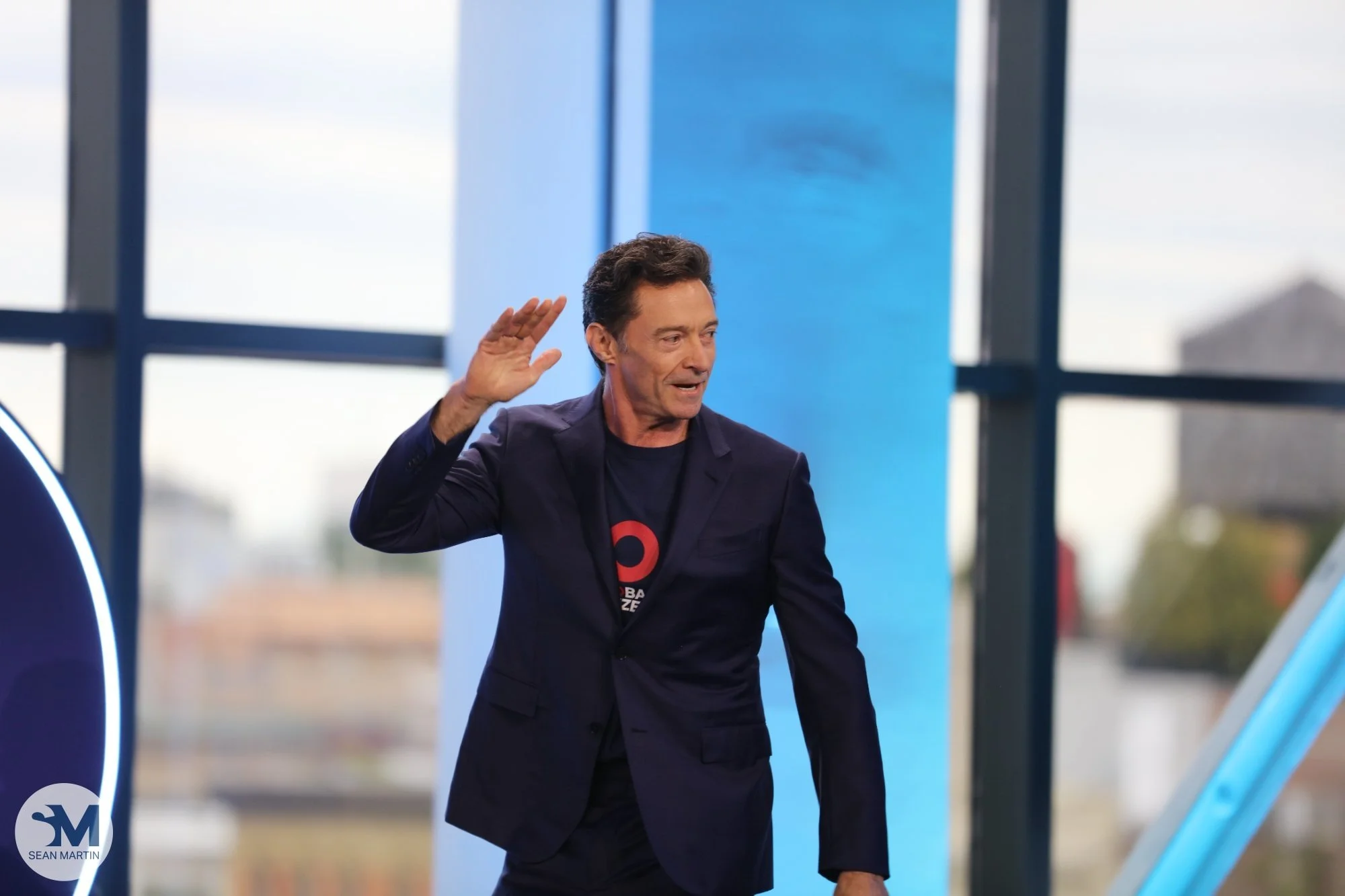
The headline number is the money. The FIFA Global Citizen Education Fund reported $47 million raised against a $100 million goal it intends to hit by the World Cup final, with grants of $50,000 to $150,000 already flowing to a first cohort of 27 organizations. Hugh Jackman, announcing them from the stage, said the programs run “from Canada, Colombia, and Brazil to South Africa and Rwanda, and right here in Harlem.”2 Fresh commitments came with them — a $1 million pledge attributed to Emerson Farrell, $3 million from the Varkey Foundation. Real money, real programs.
Alongside the fundraising came a quieter announcement: a pilot to use artificial intelligence and blockchain to verify, record, and monitor every dollar, from the moment it is donated to the point it makes impact on the ground.2 The money is the headline. The audit trail is the tell.
Development budgets are shrinking and public trust in institutions is thin, and the sector’s standing pitch has been “trust us, the money helps.” This inverts it — the claim now arrives with a receipt, traceable end to end. Benedetta Audia, who chaired the fund’s independent review committee, said accountability was “essential to our work,” describing oversight procedures built to ensure every dollar entrusted to the fund is properly accounted for.2 Accountability is being built in as a feature, not bolted on as a disclaimer. The technology’s job here is not to move money faster. It is to show where the money went.
The money is the headline. The pledge to trace every dollar, gift to ground, is the tell.
— Accountability, Built In

Lens Two · Innovation / Market
Which technologies are actually moving the outcome — and which are just moving fast?
If the blockchain pilot is the aspirational version of proof, the field deployments were the working version — and they arrived with outcomes already on the board.
Take Solar Freeze, the company built by 2026 Global Citizen Prize recipient Dysmus Kisilu.1 The model is deceptively simple: solar-powered cold storage at the farm gate on a pay-as-you-go basis, paired with a data layer connecting smallholder farmers directly to the schools, supermarkets, and hospitals that want their produce.4 The context sharpens the stakes: smallholder farmers supply roughly 30% of the world’s food while receiving less than 1% of climate financing.4 This is not “install a solar panel.” It is changing the unit economics of a tomato so it survives long enough to earn its grower an income. Kisilu’s own description of the unit is plainer than any pitch deck: “like an Airbnb, but for vegetables.”4
The scale of the underlying problem framed the energy conversation all day: around 750 million people live without electricity, 600 million of them in Africa — a continent that holds roughly 60% of the world’s renewable resources, where investment has tripled over five years.4 Homegrown renewable generation does more than power a light bulb; it ends the dependency on imported fuel that keeps decisions out of local hands.
And then the AI workforce conversation, where the enterprise numbers were genuinely striking. By Stanford’s 2026 index, 88% of organizations now use AI.5 Cisco reported training 5 million learners in a year, with 77% of its active AI users feeling more productive and 75% of affected employees placed in past restructures. One brand group described compressing a finance reporting cycle from 700 hours to roughly 100. A major fund described running an autonomous “artificial investor” trading billions, near-even against its prior system.5 Bridgewater’s Nir Bar Dea called AI “an alien technology” and warned the disruption is only beginning. Productivity, clearly. The question Lens Three returns to is whether productivity is the same thing as the outcome that was promised.
Where The Technology Already Has Receipts
Three deployments showcased across the program, each with an outcome attached rather than an aspiration.
Solar Cold Storage — Solar Freeze
Pay-as-you-go solar refrigeration at the farm gate, plus a data layer linking smallholders to buyers — cutting post-harvest loss for growers who supply ~30% of the world’s food on less than 1% of climate finance.4
Restoration Economics — Bezos Earth Fund
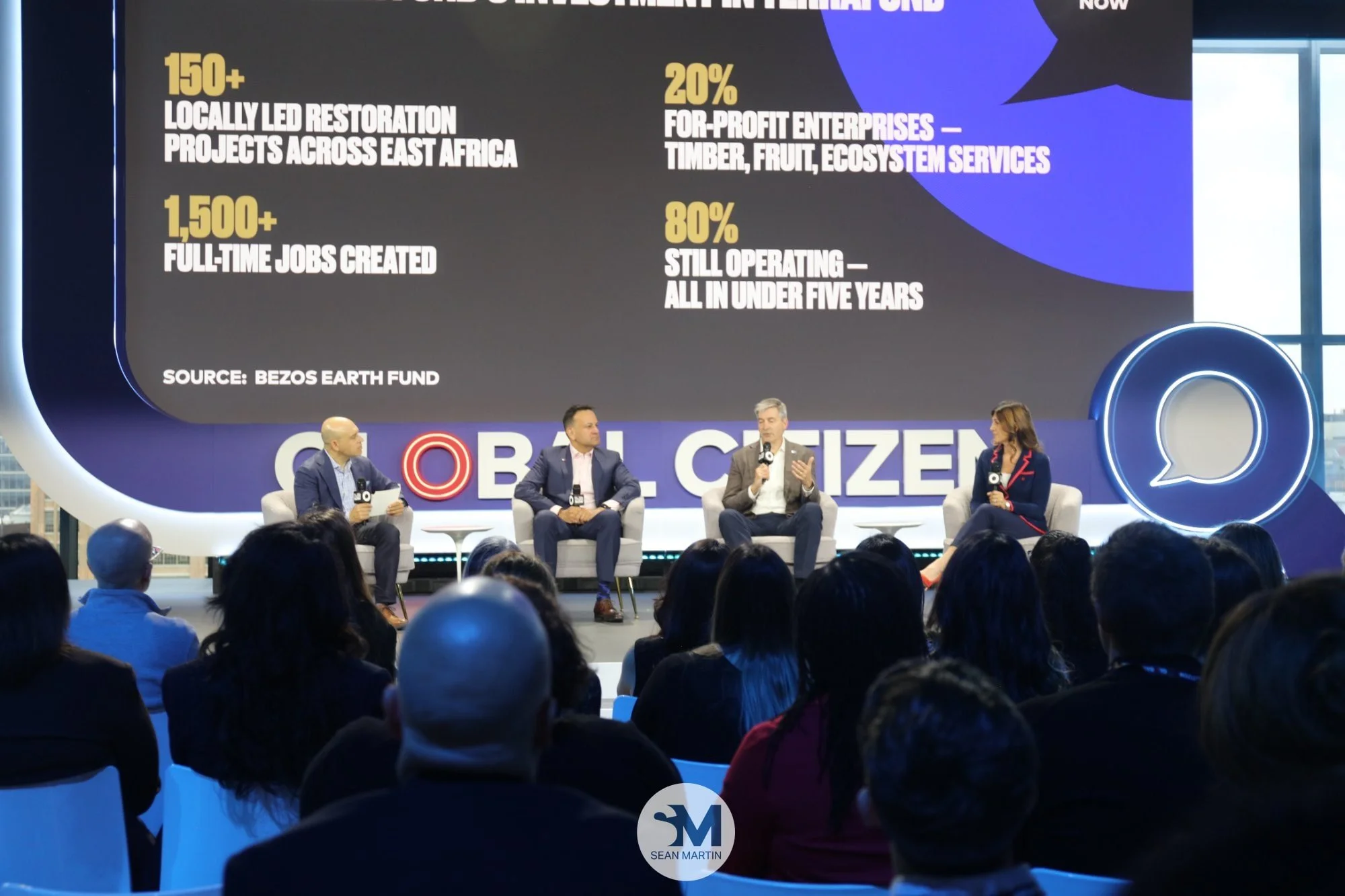
A restoration effort in East Africa, described by Tom Taylor, worked with ~150 farmers, created 1,500 jobs, and saw 80% of participating businesses turn a profit over five years — with satellites and drones now deployed against wildfire, named as the single largest annual driver of carbon emissions in a recent year.3
Small-Business Capital — PayPal
A commitment to help 25 million small businesses thrive in the digital economy by 2030, pre-positioned disaster capital so climate-exposed businesses can rebuild fast, and an impact award scaling from five recipients to fifteen across multiple countries.3
Jobs created, businesses made profitable, spoilage reduced, people reached. That is a higher bar than most “tech for good” rhetoric clears — and the event set it almost without comment.
Technology does not equalize by default. It concentrates by default. Equalizing it is work.
Lens Three · Messaging / Language
What is the word “democratizing” actually doing?
It promises an outcome the technology does not deliver on its own — and the gap is where the people who need it most fall through.
“Democratizing” was the event’s favorite verb for AI. The case made on the policy side was real and worth taking seriously — AI could widen healthcare access in places that simply do not have enough trained clinicians.3 But the word does specific work. Democratization is not a property of the technology. It is a deliverable someone has to fund, build, and distribute.
The asterisk sat on the same stage as the celebration. PayPal’s Amy Bonitatibus put numbers to it: 82% of small businesses know adopting AI is critical, she said, “but… we don’t feel that we have the tools and training” to do it.3 That gap is the whole game. Left to run on its own, the same wave that lets a hedge fund trade billions on autonomous models is the wave that disrupts the corner business that never got the training.

What “Democratizing AI” Leaves Out
01 · The Tools
Availability is not access. A model anyone can technically reach is still out of reach for a business without the systems, data, or budget to put it to work. The headline adoption rate counts organizations that already had the means.
02 · The Training
Three-quarters of small businesses say they lack the training to adopt AI. That is not a technology problem; it is a distribution-and-skills problem, and it does not solve itself by the technology getting more capable.
03 · The Capital
The organizations posting the impressive productivity gains are the ones who could already afford to restructure around AI. Without deliberate capital and program design, “democratizing” describes who benefits least as easily as who benefits most.

Who The Word “Democratizing” Forgets
— The smallholder farmer supplying a third of the world’s food on under 1% of climate finance.4
— The small business that knows AI matters but cannot get the training.3
— The worker whose role is restructured before the retraining arrives.
— The student studying by phone light in one of 600 million African homes off the grid.4
The language runs ahead of the distribution. The discipline that closes the gap is the same one running through the rest of the event: refuse to claim an outcome you cannot trace, then fund the work that makes the claim true.

The Fourth Lens
When the goal is an outcome and not a return, what is the technology actually for?
The program reality is that an outcome you cannot trace is a story, not a result. The market reality is that the technologies clearing the bar are the ones that change unit economics on the ground — a tomato that survives to market, a farm with power, a business that rebuilds after the storm. The messaging reality is that the most-used word for the most-hyped technology promises a result the technology does not produce on its own.
The people most affected by the gap between the three are not the executives on the stage or the artists who drew the cameras. They are the farmer, the off-grid student, and the small-business owner — the ones whose lives turn on whether “democratizing” was a slogan or a budget line.
Which brings the whole event back to that blockchain pilot. It is not a gimmick bolted onto a gala. It is the logical endpoint of a summit that, all day, refused to make a claim it could not quantify. The cleanest illustration of that discipline at scale was the Amazon campaign: 4.4 million actions taken, more than $1 billion in commitments, 31 million hectares of rainforest protected, and 18 million lives impacted — built on what Marcelo Thomé called the core idea, that “the forest has value when it is standing,” with capital, market access, and technical support reaching the people who actually live there.6
Technology is finally good enough to keep the receipts. The harder question is whether everyone is ready to read them.
The tracking pilot is worth watching for what it admits. An organization does not build the infrastructure to prove every dollar lands where it says unless it expects the claim to be doubted — which says something about how much weight “trust us” still carries, including for the people making the pledges.
When every dollar is finally traceable, gift to ground, the test stops being whether the sector can prove its wins. It becomes whether it will like what the proof shows. So here is the question worth carrying out of the room: when the rounding stops, how much of the impact story survives the data?
Sean Martin is a cybersecurity and technology market analyst, content strategist, and advisor with 30+ years across engineering, product development, marketing, and media. Co-founder of ITSPmagazine and Studio C60, host of the Redefining CyberSecurity Podcast and the Music Evolves Podcast. Sean works with leaders across technology, cybersecurity, and go-to-market teams to connect technology operations to real business and human outcomes. Connect at seanmartin.com.
Subscribe to Lens Four — Where business, innovation, and messaging come into focus.
References
1. “Global Citizen NOW: NYC 2026 Program,” Global Citizen — globalcitizen.org
2. “FIFA Global Citizen Education Fund,” session, Global Citizen NOW: NYC 2026.
3. “Turning Urgency into Impact: The Power of Cross-Sector Collaboration,” session, Global Citizen NOW: NYC 2026.
4. “The Cost of Darkness: Why Energy Access Can’t Wait,” session, Global Citizen NOW: NYC 2026.
5. “The AI Powered Workforce: Ushering in the New Era of Corporate Leadership,” session, Global Citizen NOW: NYC 2026.
6. “More Valuable Standing: The Amazon & the Economy,” session, Global Citizen NOW: NYC 2026.
Topics Covered In This Analysis
Global Citizen NOW, GC NOW NYC 2026, technology for social impact, tech for good, impact measurement, outcomes-based philanthropy, accountability, AI and blockchain donation tracking, traceable giving, FIFA Global Citizen Education Fund, education access, Solar Freeze, Dysmus Kisilu, solar cold storage, post-harvest loss, smallholder farmers, climate finance, energy access, energy poverty, renewable energy in Africa, Bezos Earth Fund, restoration economics, wildfire monitoring, satellites and drones, PayPal small business, digital economy, disaster capital, Mercy Corps Ventures, AI powered workforce, Stanford AI Index 2026, AI adoption, AI productivity, Cisco workforce training, autonomous investing, AI democratization, digital divide, skills gap, Amazon rainforest campaign, Green Plus Rural Fund, cross-sector collaboration, Global Citizen Prize, Lens Four, Sean Martin, ITSPmagazine, Studio C60, Redefining CyberSecurity Podcast.
Frequently Asked Questions
What is the central argument of this piece?
That technology earns its place in social impact only when it produces — and can prove — a measurable outcome. Global Citizen NOW: NYC 2026 was unusually disciplined about attaching numbers to claims, and its most consequential announcement was infrastructure for verifying that donated money does what it says.
What is the AI and blockchain donation-tracking pilot?
A pilot announced at the event to verify, record, and monitor every donated dollar from the moment it is given to the point it makes impact on the ground — framed as a way to replace “trust us” with an auditable, end-to-end record. The technology is described here at the capability level (AI + blockchain) rather than by product name.
What does Solar Freeze do?
Founded by 2026 Global Citizen Prize recipient Dysmus Kisilu, Solar Freeze provides pay-as-you-go solar-powered cold storage at the farm gate, plus a data layer connecting smallholder farmers to buyers — reducing post-harvest spoilage and raising income for growers who supply roughly 30% of the world’s food.
Why does the article push back on the word “democratizing”?
Because democratization is not a property of the technology — it is a deliverable someone has to fund and distribute. A survey cited at the event found 82% of small businesses know AI adoption is critical while about 75% lack the tools and training, which means the same wave can concentrate advantage as easily as spread it.
Is this a cybersecurity article?
No. This Lens Four edition steps off the cybersecurity beat to examine the broader use of technology to drive social outcomes, applying the same three-lens analysis — programs, market, and messaging — to the work and the numbers surfaced at Global Citizen NOW: NYC 2026.